Page created on 10/10/2024; updated on 23/04/2025.
(Mini) lathe tools
NOTICE! The lathe pros are probably going to jump out of their skin when they read the following. I beg their kind indulgence…
My need
In fact, I have a very specific need: the manufacture of insulators for the roofline of the Lima and Piko BB 17000. I haven’t found anything similar on the market. I’d thought of asking REE for a BB 16000 part, but there are too many differences.
Problem: I don’t own a lathe, and even if I did, I haven’t found a lathe tool that would be suitable for this application, in particular, a tool that can make triangular grooves with an inclination of about 22°. See this catalogue page, for example.
I only own a mini drill and a milling machine. The main disadvantage will be the lack of rigidity, implying a risk of vibration. Regarding the modified mini drill (see this page), it needs to be placed horizontally in its support. The tool will be fixed to the cross table. The X axis of the table will be the “turning” axis (so in fact the Z axis in turning terms, if I’ve understood correctly), the Y axis of the table being the one for facing, cutting, etc. (so in fact the X axis in turning terms, go figure…). In the case of the milling machine, I’ll be able to use the Z axis for longitudinal turning and the X axis for the other operations. The disadvantage of the latter solution is that collets are not well suited to gripping short workpieces: there will still be a fair amount of wasted length.
My idea is to use broken carbide 3.2 mm bits – I’m not short of them – ground to suit my needs. I’ll also need a sufficiently rigid toolholder.
The toolholder
The toolholder is based on a steel ballast block from an antique BB 17009 Lima purchased in 1972. And so we come full circle! For some reason, I had cut the block into two equal halves. We’ll see that both parts will be useful.
First, I have to properly straighten the faces of each block on my milling machine, using an 8 mm cutter, in 0.1 mm passes. The material is soft enough and poses no difficulty. However, I lubricate it with WD40.
One block is then drilled and tappered according to this plan.
- Hole for tool.
- M4 tapped holes for clamping screws.
- Hole for M6 fixing stud on cross table.
Making a tool
Starting with a broken carbide drill bit, using a diamond disc, I begin by machining a flat on the shank, which will serve as a reference. Grinding depth: 0.5 mm. It could be more.
Click on the photo below to zoom in.


Note: the toolholder used here is an unsatisfactory test which doesn’t conform to the plan given above. In particular, it has only one clamping screw.
The future tool is turned over and locked by the clamping screw on its flat. With the toolholder turned 90°, I machine the first side face to a depth that depends on the desired thickness. Here, for a final thickness of 0.3 mm, on a 3.2 mm drill, I need to remove 2.9 / 2 = 1.45 mm on each side. I proceed in passes of 0.2 mm.

Click on the photo to zoom in.
The grinding of the opposite face is not shown.
Grinding the end, for a clearance angle of around 7 to 8°. Note the inclined holder for this purpose.

Click on the photo to zoom in.
Grinding the cutting edge, again with the holder tilted to give a rake angle of just over 90°.

Click on the photo to zoom in.
Here are some of the tools made. From left to right, three straight tools 0.3, 0.5 and 1 mm wide, then two tools with a 22° inclined face for machining insulators. They don’t look great, but if they do the job… That’s what we’re going to check.

Application and testing
Here’s the general setup, with the drill swivelled 90° and lowered enough for the tool to be at the correct height. This is obviously only possible because I’ve fitted a Z-axis adjustment to the support.

Because the drill was coming up against the table, I had to raise the toolholder using the other half of the ballast used to make it, the half I used to machine the tools. I milled a groove the width of the toolholder, and 0.5 mm deep, so that the two parts are correctly aligned: this makes squaring on the table easier. Of course, a one-piece part would have been preferable. On the plan, the height of the toolholder is sufficient so that it doesn’t need to be raised.
You can see the fixing stud, taken from an M6 threaded rod, because the studs supplied with the table were too short.
Another view of the device.

Click on the photo to zoom in.
Machining parts
To make things easier, I dimension the part as shown on the drawing (example: line insulator). This way, the values correspond directly to the graduations on the cross table.
The Y axis zero is set flush with the workpiece, in this case a ⌀ 2.5 brass rod.
I proceed as follows, with only the 22° tool. Given that this tool is far from perfect and the fixture lacks rigidity, I can only proceed very carefully, in 0.1 mm passes.
- Longitudinal turning the foot over 2 mm, depth 0.6, to obtain diameter 1.3, then the tenon over 1.5 mm, depth 0.75, to obtain diameter 1 mm which will then need to be checked and rectified.
- Turning the “plates”, depth 0.6.
- Turning the upper collar to obtain diameter 1 mm.
- Reducing the diameter of the plates, from left to right, successive depths: 0.26, 0.18 and 0.09 (all theoretical values!).
- Refining the reduced plates by taking up the grooves at depth 0.75 and moving back slightly.
- Using 400-grit sandpaper, folded in 2, to deburr and round off the corners a little.
- And finally cutting the finished piece with a jeweller’s frame saw.
I successively made four line insulators, two circuit-breaker supports and a roof penetration, without too much difficulty.
An example of realization
This example is described in detail in the article on BB 17041 Lima. This photo shows raw parts, that have just been soldered.

Using the tools with the Proxxon FD 150/E lathe
Having recently received this mini-lathe, I wanted to use it with my tools. To do that, I need a new toolholder. In the meantime, I sawed the one I described above. But I did it before I got the lathe. So I had to adjust the height using shims. So what the photo shows is just an infamous bit of tinkering while I wait for a suitable part, which I’ll talk about later.
Test
The test consisted of machining a 3 mm brass rod, mounted in an ER11 collet and supported by the movable tailstock.

Click on the photo to zoom in.
Although I proceeded very carefully, I was surprised to see my tools break one after the other!
The reason for this is that, on the drills used, the carbide tip is crimped into the body. The grinding carried out during shaping seriously weakened this crimp, causing the carbide tip to escape!

The photo shows a loose tip ready to escape, and another drill bit with no tip at all!
One question remains: why didn’t I break anything using the mini drill? I think the answer lies in the rigidity of the assembly: with the drill, there is a general lack of rigidity, from the support to the workpiece, which is cantilevered. With the lathe, the support is incomparably firmer, so the cutting force can be much greater on the tool.
Some tools are remade with the carbide tip removed. The disadvantage is that they are shorter.
Viewed in very close-up, these tools reveal defects in appearance. However, they cut brass correctly — and that is the main thing!
From left to right, 1, 0.5, 0.3 mm straight-cutting, and 22° special “insulator” tools.

An adapter for the Proxxon lathe
Here is a project for an adapter to use my tools on the Proxxon lathe, with the original toolholder, designed for 6 × 6 mm section tools. The part will be made from 6 mm thick flat steel bar.

Here are the dimensions:
Making
I will pass modestly over the first two parts, which were more or less unsuccessful, mainly due to a lack of rigour on my part. I did not take any photos of the construction, as I was too busy with it.
Here is the third and final part, far from perfect, but with dimensions very close to the plan. The clamping screws are in place and a 0.5 mm wide cut-off tool is fitted.
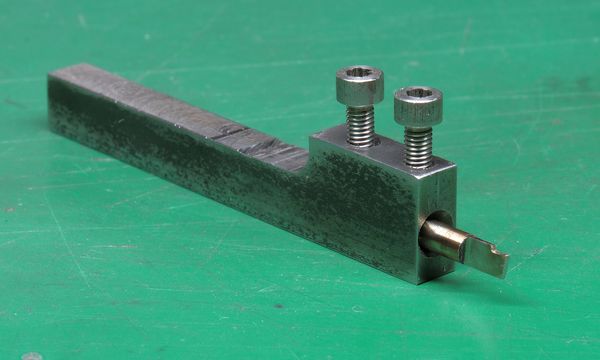
The tests were satisfactory. The only minor problem is that each tool requires a different spacer, ranging from 0.4 to 0.6 mm. Remember that Proxxon tools also require a 0.5 mm spacer.
Turning inserts, length 24 mm.
Bimu turning inserts 040line.
Proxxon Micromot 50/E +
Support MB 140/S +
Table KT 70, étau MS 4.
Milling machine BFW 40/E +
Primus 75 vice.
That was before!
I’ve got one now (April 2025).
See the article The Proxxon FD 150/E lathe.