Page created on 15/06/2025; updated on 19/09/2026.
Brand - Reference
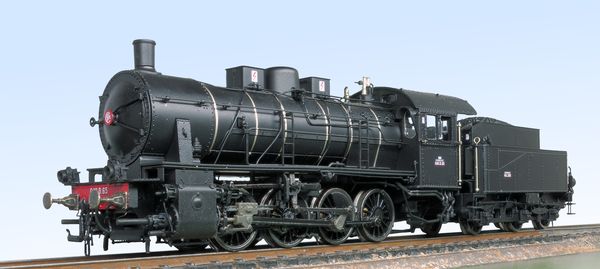
Hornby-Jouef HJ2417
Type
2 040-D-65 and tender 16-C-305.
Weight loco / tender
211 g / 100 g
Current at slipping / stalling @ 12 V
340 mA (fwd), 280 mA (bkwd) / 420 mA.
Comments
Except for the rear of the tender, the couplings have a slight elongation. The front coupling can only be used by removing the steam pipe and shortening the brake hose. The rear coupling of the tender has no elongation at all; it has a very basic and overly stiff return mechanism consisting of a simple plastic extension of the NEM housing. The tender front coupling is longitudinally adjustable.
Operation is quiet and idling is very good. Installing a decoder (non-sound) is not very difficult, but it should be noted that removing the coal box to access the connector is easier by applying pressure to the middle of each side of the bunker. The trickiest part is removing the “dummy” plug without bending the pins. A small extractor with two claws would be useful. As for the method indicated for a sound decoder, when I removed the four screws under the chassis, I was unable to lift the body… Good luck to anyone who wants to install a speaker. The French translation of the instructions is not very serious: even the most basic automatic translator does better!
The white lights are excessively bright, especially on the tender end. There are no red lights. After installing the decoder, I reduced the brightness of the front lights by a factor of 8 and that of the rear lights by a factor of 32!
The brass-coloured boiler circles will need to be repainted black, and the buffers replaced.
The bag of parts contains a ski for three-rail operation, a standard coupling, a steam pipe, a brake hose, and a dummy but articulated screw coupling (another one is mounted as standard on the buffer beam).
Last minute update: after only a few wheel revolutions and the slip test, the machine has already lost a traction tyre. Easily replaced, but clearly too loose.
See the Loco-Revue Forum (for Nord version).
Modifications
- Installation of a Lenz Silver+ 21MTC decoder.
- As I do not have suitable replacement tyres (width 1.2 mm, whereas the Roco are 1.6 mm), I tried gluing the existing wheel tyres with a little diluted Kristal Klear. The crankpins on the driving axle can be unscrewed with a 2 mm spanner.
- Replacement of the buffers with Nord models. Photo.
In this regard, the latest version of the manual no longer mentions the CVs for assigning function keys (mapping) or for dimming outputs. However, they are still functional. Please refer to older versions, as the page indicated on the Lenz website does not provide any information. And the downloadable manual is exactly the same as the paper version! If even the Germans are getting in on it…
History
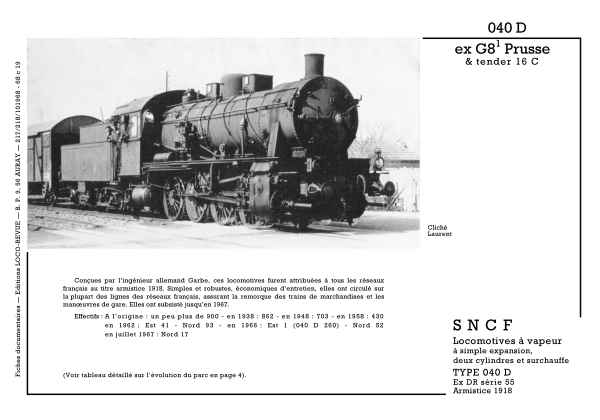
The history of these German-made locomotives (G8.1) is quite complicated. They were built between 1912 and 1921 by various German companies, including Henschel and Hanomag (comprehensive list in the Loco-Revue sheet).
As for the machines in the Nord region, 212 of them were delivered to the Compagnie du Nord under the terms of the First World War armistice. They were registered as 4.351 to 4.562 with this company, then as 2-040.D.1 to 212 when the SNCF was created. Their number rose to 274 in 1950 after machines from other regions were added, then fell to 50 in 1966. The last eight were withdrawn in 1969.
Main characteristics: boiler rated at 14 bar; 2 cylinders and superheater; adhesive weight 67 t; maximum speed 55 to 60 km/h; wheel power 920 kW (1 250 hp); tractive effort 240 kN (24.6 t).
Most of the coupled tenders have three axles with a capacity of 16.5 m³ of water and 7 t of coal. Tare weight 21 t.
Documents
- Loco-Revue sheet
No. 217/218 (older series No. 19). Sheet preview.
- Wikipedia article (in French).
- HJ instruction leaflet..
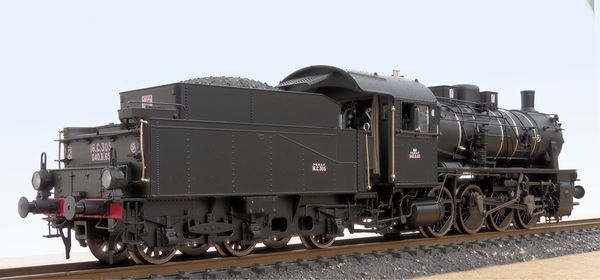

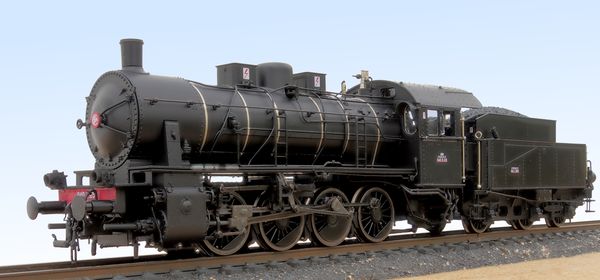

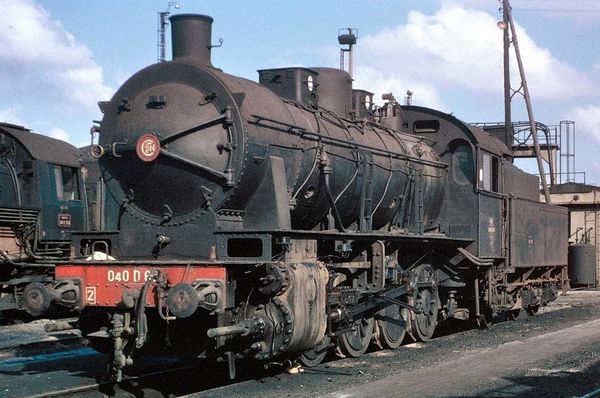
Anonymous photo published by Hornby-Jouef.
 |
| Loco dimensions | Actual | 1:87 | Model |
|---|---|---|---|
| Overall length | 10 880 | 125.1 | 124.2 |
| Chassis length | 10 230 | 117.6 | 117.2 |
| Overall width ² | 3 100 | 35.6 | 35.8 |
| Width at the cylinders | 2740 | 31.5 | 33.4 |
| Boiler diameter | 1 598 | 18.4 | 20.3 ³ |
| Cab height | 4 095 | 47.1 | 47.2 |
| Chimney height | 4 250 | 48.9 | 49.4 |
| Centre distance A | 1 570 | 18.0 | 17.9 |
| Centre distance B | 1 560 | 17.9 | 17.9 |
| Centre distance C | 1 570 | 18.0 | 17.9 |
| Wheel diameter | 1 350 | 15.5 | 15.4 |
| D | B | U | |
| 1.0 | 14.4 to 14.6 ¹ |
— | |
|
|||
| Tender dimensions | Actual | 1:87 | Model |
|---|---|---|---|
| Overall length | 7 310 | 84.0 | 83.7 |
| Chassis length | 6 660 | 76.6 | 76.5 |
| Overall width | 3 000 | 34.5 | 34.8 |
| Height | 3 350 | 38.5 | 38.4 |
| Centre distance D | 2 400 | 27.6 | 27.3 |
| Centre distance E | 2 000 | 23.0 | 23.0 |
| Wheel diameter | 1 040 | 12.0 | 11.4 |
| D | B | U | |
| 1.05 | 14.5 | — |
Document available as a PDF.
If you are interested, please let me
know by e-mail,
specifying the title of the document-s.
For conditions,
see page
Fiches documentaires Loco-Revue. .
Preliminary note: I don’t know enough about steam to judge whether a particular component, such as an injector or pump, is correct.
The model is well proportioned and almost exactly to scale. There is a profusion of handrails and very fine pipes. Unfortunately, some of them are loose, as is one of the locomotive’s coupling handles.
Only the rear axle of the locomotive is driving and has rubber tyres; the other are driven by the connecting rods. The four axles have current pickups. The distribution counter-cranks have a lot of play when rotating. The tender also collects the current; it accepts an MTC21 decoder, and is connected to the locomotive by an eight-pole electrical connector. The central axle has relatively significant lateral play and is suspended by two coil springs rubbing directly on the insulating sleeve of the axle. What about wear and tear?