Page created on 13/11/2017; updated on 13/02/2023.
Brand - Reference
LS Models 41071
Type
Type P sleeping car (Pillepich)
| UIC number | ex-CIWL | Rev. date |
| 61 87 75-30 740-7 | 4550 | 10.7.80 |
| Home: 5 Villeneuve Prairie | ||
Weight
159 g; 130 g after removing the ballast (NEM: 110 to 143 g).
Comments
Excellent respect of the scale.
The roof and the body are one part.
The bogies are equipped with brass bearings and have fine-flange wheels (0.55 mm). A bag includes larger flange wheel sets if needed. Few parts are to be assembled: jumpers, half brake hoses, (dummy) screw couplings.
The plastic material of buffers, bogies and gangways is translucent and need to be painted.
Coach a little too heavy.
See :
- Forum Loco-Revue.
- gamos81.altervista.org for the reference list of issued P sleeping car models.
Modifications
- Ballast (29 g) removed.
- Bogies painted in Interfer slate gray; wheels painted in Humbrol Enamel 113 (rust) and 224 (slate gray) blending.
History
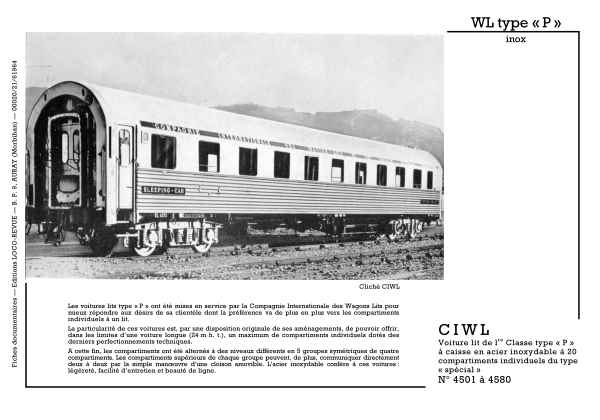
Characteristics: 20 first-class seats in nested compartments. Stainless steel body. Schlieren bogies. Tare 44 t. Speed limit 140 km/h.
Originally equipped with bellows, they were, probably in the early 1970s, equipped with UIC rubber joints on prominent box.
Example of incorporation, according to Pierre B. on the Loco-Revue forum: train 197/152 Paris ↔ Warsaw (P sleeping car Paris ↔ Dortmund) in 1959. But unfortunately no compositions on the Nord in the 1970s.
Documents
- Loco-Revue sheet
No. 21/22 (older series No. 2). Sheet preview.
- Le Train No. 203 of March 2005
- Wikipedia article
- eurocity64 website.
- German website Wagons-Lits
- scalaenne website (in Italian).
- LS Models instruction leaflet.


Photo Tobias B. Köhler on railfaneurope.
| Dimension | Actual | 1:87 | Model |
|---|---|---|---|
| Overall length | 24 000 | 275.9 | 276.0 |
| Body length ¹ | 23 164 | 266.3 | 265.3 |
| Chassis length | 22 748 | 261.5 | 261.7 |
| Width | 2 865 | 32.9 | 33.7 |
| Height | 4 253 | 48.9 | 48.5 |
| Pivot distance | 16 500 | 189.7 | 189.7 |
| Bogie wheelbase | 2 500 | 28.7 | 28.6 |
| Wheel diameter | 1 000 | 11.5 | 11.6 |
|
|||

Interior design (CIWL leaflet).
Document available as a PDF.
If you are interested, please let me
know by e-mail,
specifying the title of the document-s.
For conditions,
see page
Fiches documentaires Loco-Revue. .
Series of 80 sleeping cars No. CIWL 4501 to 4580, built under Budd licence in Belgium by Ateliers Métallurgiques in Nivelles (4501 to 4525), in France by Carel & Fouché (4526 to 4550), in Italy by Ansaldo and Fiat, put in service from 1955 to 1956. Type P refers to their designer, Albert Pillepich, chief engineer of CIWL’s technical services (sources: CIWL).