Page created on 20/11/2012; updated on 15/04/2017.
Brand - Reference
Jouef (1) HJ6100, HJ6121 and (2) HJ6154
Type
UIC/ORE Standard II-type Gs 4.01
| UIC number | Revision date |
| 01 87 121 2 428-0 | 29.9.80 |
| 01 87 120 2 009-2 | 28.8.80 |
| 01 87 120 5 032-9 | 12.2.79 |
| 01 87 121 0 322-7 | 14.9.72 |
Weight
68 g (NEM: 49 to 63 g).
Comments
Globally, very good Jouef, or Electrotren instead! It can be seen in the brake half-coupling that dangles instead of being hung on its support!
(1) Gs 40.1 registration erroneous. For the time, before 1980, it should be Gs 4.01.
(1) Ugly enough wheels for the HJ6100 (look like the old Jouef!), flanges 1.3 mm high. The handles, handrails, brake handles, and brake lever connecting rods are metallic and very thin; towing hooks and brake equipment are inserted. Spare steps are provided only for HJ6100.
(1) Bad surprise: these two wagons refuse to couple (drawbars too short) and the buffers can get caught on other wagons! In fact, according to the table of dimensions, the buffers are 7.5 mm long instead of 7.1. Two possible remedies: lengthen the drawbar a little (spacers of 0.5 mm should suffice), or shorten the buffers, whose rod, fitted on the body, is more or less firmly glued.
(2) This time, the Gs 4.01 type is correct.
(2) Nickel plated wheels always too showy. The ventilation grilles, apparent, are very thin and slatted. The diamond meshes are photo-etched, as well as the inserted label holders.
(2) A nice little attention: the standard couplings are mounted in their boxes, but not snapped, which makes them much easier to remove and replace them, and therefore with less risk for the steps, for example…
(2) A little unlikeable cheating: in the advertisements, the shutters
were in a different colour from that of the body. This is not the case
for the models provided.
(2) The end steps are quite fragile: one was already broken when taking it off the box. The central steps, on the other hand, are of flexible material, less fragile, but tend to escape. To glue on!
Modifications
Wheels, buffers, steps, and brake blocks painted. Wheels changed for the HJ6100.
History
The most apparent differences between types G4.01 and G4.02 are:
- the position of the brake wheels (when they exist), at the end for the G4.01, to the middle for the G4.02;
- the end stiffeners, of constant section for G4.01, of section decreasing from bottom to top for G4.02;
- the end steps, arranged diagonally for the G4.01, on the same side for the G4.02.
Whether the body is in wood planks or in “Permaplex” (plywood) is not a relevant criterion.
Documents
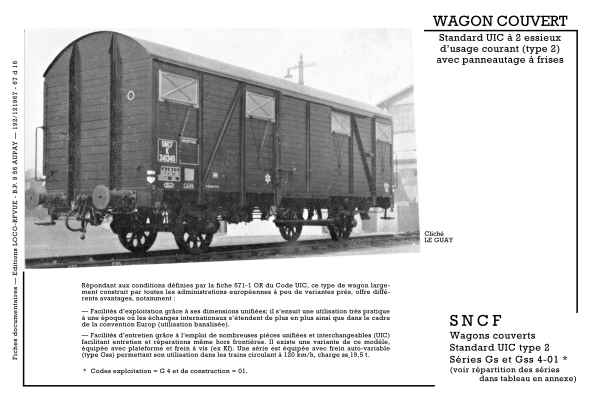
- Loco-Revue sheet
No. 192 (older series No. 16). Sheet preview.
- SNCF 1973 booklet
Wagons à marchandises, p. 30 :
specifications and photo of 01 87 120 9 784-1.

- Loco-Revue Special Issue Real Railways No. 2 (April 1999) p. 9, photo 20.
- Ferrovissime Special Issue No. 7, p. 83 to 85.
- Loco-Revue Forum on the G4 (many photos).


| Dimension (1) | Actual | 1:87 | Model |
|---|---|---|---|
| Overall length | 10 580 | 121.6 | 122.0 |
| Chassis length | 9 340 | 107.4 | 107.0 |
| Width | 2 800 | 32.2 | 31.6 |
| Height | 4 010 | 46.1 | 46.3 |
| Wheelbase | 5 700 | 65.5 | 65.8 |
| Wheel diameter | 1 000 | 11.5 | 11.3 |
| Dimension (2) | Actual | 1:87 | Model |
|---|---|---|---|
| Overall length | 10 580 | 121.6 | 122.4 |
| Chassis length | 9 340 | 107.4 | 107.2 |
| Width | 2 800 | 32.2 | 32.3 |
| Height | 4 010 | 46.1 | 46.6 |
| Wheelbase | 5 700 | 65.5 | 65.4 |
| Wheel diameter | 1 000 | 11.5 | 11.5 ¹ |
|
|||
Document available for free as a PDF.
If you are interested, please
let me know by e-mail,
specifying the title of the document-s.
For
conditions, see page
Books and
magazines.
.
UIC/ORE II-Type Standard Gs 4.01 covered wagons, built between 1957 and 1962, by De Dietrich, SNAV, ANF, CFMf, Marpent, H.K. Porter, Frangeco, numbered in series 01 or 21 87 120 0 000 to 121 3999 (approximately 13,000 wagons).
Main specifications: usable volume 63 m³; usable floor area 25 m²; average unladen weight 11.5 t; C-load in R.O. (ordinary regime) 28 t.