Page created on 28/03/2026.
Brand - Reference
Van Biervliet VB-3602
Type
NMBS 5131
Weight / current at slipping @ 12 V
490 g / ? A
Comments
Excess oil has leaked under the bogies and onto the roof. Quite ironic when you consider that the manual advises against the use of oil…
The decoder supplied is an ESU Lokpilot 5, address 51 (specified in the instructions, but it should be 3 by default). I was unable to measure the currents because of this pre-installed decoder.
None of the wheels have a traction tyre; all are driving.
The engraving is decent, but no better than on the 6321, which was marketed as a budget model and was much cheaper. On the other hand, the corner ladders are thinner, but the windscreen wipers are coarser…
The elongating drawbars are removable.
Opening
Once the instructions have been translated, we learn that the body is secured by four screws, under the bogies, towards the middle: do not confuse these with the screws securing the drawbars. I wanted to open it because I could hear the sound of small parts rattling around inside. I was right to do so, as the culprits were the two fixing screws for a cabin fitting! They could have caused damage, either mechanical or electrical.
Photo of the model opened up.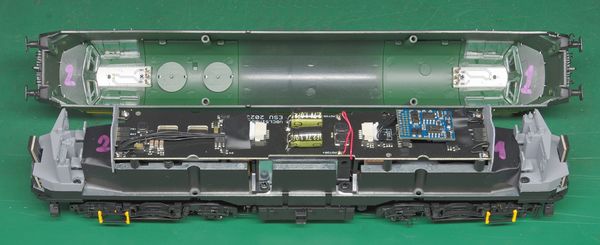
The printed circuit board is quite complex and features two 1 F / 2.7 V supercapacitors. There are no wires connecting this circuit to the body: the connections to the cab LEDs are made via spring contacts.
During my inspection, I noticed that a current pickup strip was positioned above the wheel rather than behind it. It’s clear that the quality of the finish could be improved.
A tip for reassembling the body if you haven’t identified the direction: look at the wheel numbers marked on the body; the highest numbers (7 to 12) correspond to end 2, and therefore to the bogie with the greatest cantilever.
See tassignon.be for the list of models produced or announced.
Modifications
- The loose screws are refit.
- The incorrectly fitted current pickup are refit.
History
A series of 93 diesel locomotives with electric transmission built by Cockerill-Ougrée between 1961 and 1963. Originally numbered in the 200 series, they were redesignated as the 5101 to 5193 series in 1971.
Cockerill-Ougrée diesel engine. A.C.E.C. (Ateliers de constructions électriques de Charleroi) main generator and six traction motors under licence from Westinghouse.
Wheel arrangement: Co’Co’. Diesel engine power (8-cylinder in-line): 1 435 kW at 650 rpm. UIC electrical power 1 145 kW; maximum starting force 272 kN. Operating weight 113.2 to 117 t depending on sub-series. Maximum speed 120 km/h.
These locomotives were originally fitted with a boiler for heating passenger trains.
Documents
- Wikipedia article.
- Fiches descriptives du matériel de traction sur tassignon.be, page 6.
- Ferrovia.be website.
- Instructions for B-Models / Van Biervliet 51 series locomotives, with French and English translations by DeepL and myself.
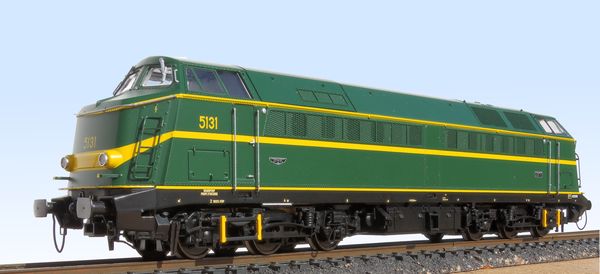

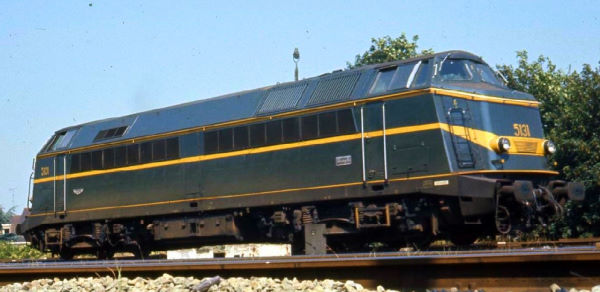
Anonymous photo on Van Biervliet website.
| Dimension | Actual | 1:87 | Model |
|---|---|---|---|
| Overall length | 20 160 | 231.7 | 232,0 ¹ |
| Chassis length | 19 010 | 218.5 | 219,0 ¹ |
| Width | 2 905 | 33.4 | 34.5 ² |
| Height | 4 252 | 48.9 | 49.4 ³ |
| Pivot distance | 10 600 | 121.8 | 119.5 |
| Bogie wheelbase | 4 000 | 46.0 | 45.6 |
| Wheel diameter | 1 010 | 11.6 | 11.6 |
| D | B | U | |
| 1.2 | 14.35 ⁴ | — | |
| NB: The front and rear cantilevers are different, at 4 010 and 4 400 respectively. The model reflects this specification. | |||
|
|||
The machine arrived from the brand’s shop in very neat packaging: the outer packaging is the same as the inner one, thick black foam.
No instruction manual is provided, just a simple card with a QR code. The manual obtained is very brief, in Dutch only. No assembly diagram, no parts list. The PDF page about the digital functions is, however, bilingual.